Top LED Lighting Manufacturers for Global Buyers?
Choosing the right Led Lighting manufacturer requires more than comparing prices on a website. Global buyers need dependable products, clear documentation, and evidence of consistent factory performance. A supplier may show bright showroom images, yet the real test appears in beam uniformity, heat management, driver quality, and long-term lumen maintenance. Small details matter.
This guide examines leading LED lighting manufacturers serving international markets. It considers manufacturing experience, product engineering, quality-control systems, certifications, warranty terms, and export capability. Buyers should review photometric files, test reports, sample performance, and installation guidance before approving large orders. A reliable manufacturer should explain its LED chips, thermal materials, protection ratings, and production tolerances without vague promises.
Price is important, but replacement costs can quickly change the calculation. A failed floodlight above a warehouse entrance creates labor, safety, and scheduling problems. Strong suppliers usually provide traceable batches, responsive technical support, and realistic delivery estimates. They also understand regional voltage requirements and local project conditions.
No single manufacturer fits every buyer. That is worth remembering. A hospitality project may value color consistency, while a logistics site may prioritize efficiency and impact resistance. Some supplier claims still deserve closer verification, especially when independent testing is limited. This overview offers a practical starting point for comparing global manufacturers, while encouraging buyers to conduct their own sample checks and commercial due diligence. Reliable decisions come from evidence, not impressive claims alone.
Definition and Scope of the Global LED Lighting Manufacturing Industry
Definition and Scope of the Global LED Lighting Manufacturing Industry
The global LED lighting manufacturing industry covers more than finished bulbs. It includes LED chips, packages, drivers, heat sinks, modules, luminaires, controls, sensors, and connected software. Manufacturers may design products, assemble components, or manage contract production across several countries. This boundary is not perfectly clean. A luminaire assembler and a semiconductor producer can both appear in the same industry statistics.
The International Energy Agency reported in Energy Efficiency 2024 that lighting represents about 15% of global electricity consumption. Its analysis also shows that LED adoption is reducing energy demand, although installation quality affects real savings. The U.S. Department of Energy’s Solid-State Lighting R&D Opportunities report identifies efficiency, thermal management, optics, and controls as continuing technical priorities. These details matter to global buyers. A factory with strong chip access may still deliver weak light distribution or short driver life. Market size alone cannot prove manufacturing capability.
Tips: Check the complete supply chain, not only the factory address. Request LM-80 or equivalent LED data, driver test records, photometric files, and warranty conditions. Compare efficacy in lumens per watt, color consistency, flicker performance, and thermal results. Ask who owns the design and who performs final testing. Certifications can support trust, but they do not replace independent verification. I have seen specifications look impressive on paper, yet field performance remained uncertain. That is the uncomfortable part.
Global LED Lighting Manufacturing Industry: Market Outlook
The global LED lighting manufacturing scope includes LED lamps, luminaires, retrofit products, professional lighting systems, and related control components. The market value is projected using the published 2023 baseline and compound annual growth rate.
Unit: USD billions. 2023 baseline: approximately $78.26 billion; 2024–2030 values are calculated using an 11.0% compound annual growth rate. Source: Grand View Research, “LED Lighting Market Size, Share & Trends Analysis Report.”
Criteria for Evaluating LED Lighting Manufacturers Worldwide
Global buyers should evaluate LED lighting manufacturers through evidence, not attractive catalogs. The IEA’s 2024 Energy Efficiency Market Report indicates that LEDs now represent roughly half of global lighting sales. That shift makes product quality more important. Ask for verified efficacy, lumen maintenance, color consistency, and operating temperature data. The U.S. Department of Energy’s 2023 solid-state lighting report notes that laboratory LED packages can exceed 200 lumens per watt, while commercial products differ greatly.
Testing documents reveal practical competence. Look for LM-79 reports covering photometric performance and LM-80 data supporting LED lifetime projections under TM-21 methods. Check whether independent laboratories issued the reports. Review power factor, total harmonic distortion, flicker measurements, and surge protection.
IEEE 1789 guidance is useful when assessing potential flicker risks. A serious manufacturer should also provide IEC safety documentation, photobiological assessments, and suitable ingress protection for outdoor fixtures.
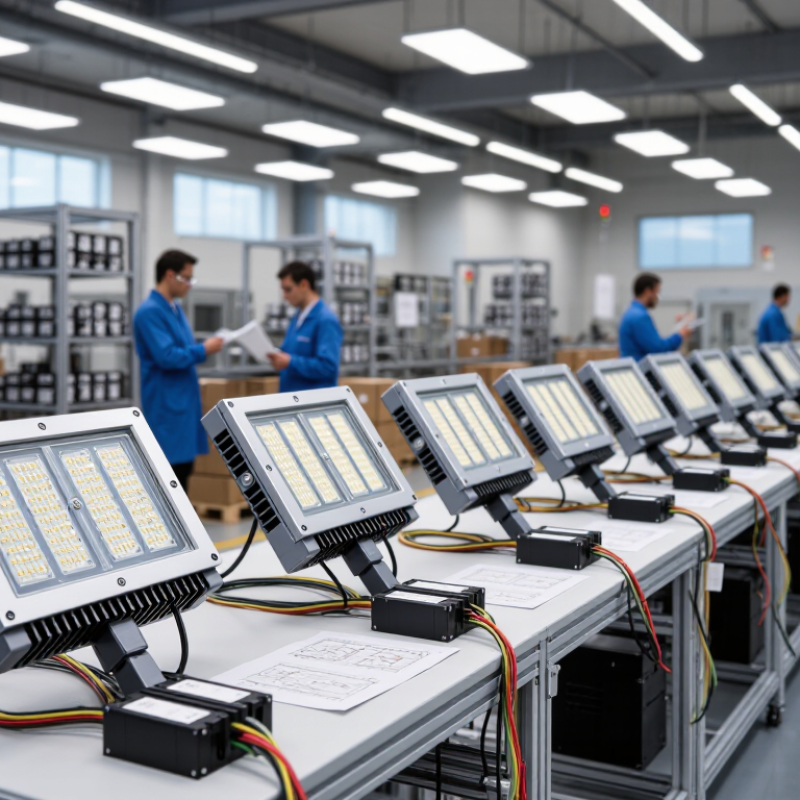
Factory experience matters as much as specifications. Request sample units from the same production line, then inspect wiring, thermal paths, driver components, and labeling. Compare measured output after extended operation, not only at startup. Warranty length helps, but warranty conditions matter more. I have seen impressive datasheets fail under dusty, hot installation conditions. No scorecard is perfect. Buyers should record test results, batch numbers, and corrective actions before approving large orders. Even small inconsistencies can become expensive across thousands of fixtures.
Leading Regional Markets and Manufacturer Selection Considerations
Global LED demand is growing, but regional priorities differ sharply. Grand View Research’s 2024 LED Lighting Market report estimates strong growth through 2030, led by Asia-Pacific. China, India, and Southeast Asia offer scale, expanding infrastructure, and competitive production. Europe places greater weight on energy performance, product transparency, and circularity. North American buyers often prioritize commercial retrofits, controls, warranty support, and documented testing. These markets need different manufacturer profiles.
SELECTION
Selection should begin with application data, not catalog claims. Ask for LM-80 testing, TM-21 projections, photometric files, surge protection details, and thermal test results. The U.S. Department of Energy’s Solid-State Lighting research shows that thermal management strongly affects LED lifetime and performance. The International Energy Agency’s 2024 Energy Efficiency report also identifies efficient lighting as an important electricity-saving opportunity. A low unit price still looks attractive. It may not be. Poor heat dissipation, unstable drivers, or weak after-sales service can increase total ownership costs. I have seen technically impressive samples fail during installation reviews.
Tips: Compare five-year operating costs, not only purchase prices. Check regional certifications and importer responsibilities. Request samples from the actual production line. Confirm spare-part availability. Review lumen maintenance data at the expected ambient temperature. Also test dimming compatibility with local control systems. A factory’s production capacity can be impressive, yet its quality process may remain inconsistent. That deserves careful questioning.
Global Standards, Certifications, Supply Chains, and Future Trends
Top LED Lighting Manufacturers for Global Buyers?
Global buyers should evaluate LED manufacturers through standards, measured performance, and supply-chain resilience. The International Energy Agency estimates that lighting consumes roughly 15% of global electricity. Efficiency claims therefore require evidence, not attractive brochures. Ask for LM-80 data, TM-21 projections, and tested system efficacy. Marketing language is not a test report.
Safety documentation matters across borders. Request compliance with IEC 60598 for luminaires and IEC 62471 for photobiological safety. ISO 9001 can indicate controlled production, but it does not guarantee excellent lighting. Check each certificate’s scope, expiry date, and factory location.
Batch codes, incoming inspection records, and driver test results reveal more than a logo. A certificate is not proof of consistent quality. This is where many purchasing teams oversimplify.
Supply chains deserve equal attention.
UNCTAD’s Review of Maritime Transport 2023 states that over 80% of global merchandise trade moves by sea. Buyers should confirm component origins, alternative suppliers, lead times, and packaging durability. A damaged carton can erase a factory’s efficiency advantage. Future-ready manufacturers are adding sensors, dimming controls, recyclable housings, and repairable drivers. The U.S. Department of Energy’s solid-state lighting research continues to emphasize efficiency, controls, and useful life. Connected lighting is promising, but interoperability remains uneven. Smarter is not always simpler. Procurement teams should test products in real rooms, under dust, heat, voltage variation, and long operating hours. That practical evidence may challenge the datasheet.