Best Commercial Exterior Lighting Manufacturers in China?
Choosing among the Best Commercial Exterior Lighting Manufacturers in China takes more than comparing prices or polished product photos. A reliable shortlist should show how each supplier handles real project conditions, from a humid coastal walkway to a loading yard exposed to dust and vibration. The right Commercial Exterior Lighting must provide suitable light distribution, robust construction, and dependable performance after installation.
Look closely at product details. Ask for photometric files, color-temperature options, ingress-protection information, driver specifications, and clear warranty terms. Confirm whether the manufacturer can explain beam angles for a building façade or recommend mounting heights for a parking area. These conversations reveal more than a broad catalog does. Request samples when practical, then inspect the finish, seals, wiring, and heat management. Small details matter.
No shortlist is perfect. A capable factory may still be a poor fit for a particular project, and a low quote can omit important components. Compare equivalent specifications, production capacity, communication, and documented quality checks. If possible, review relevant installation references and clarify how replacement parts are handled. Do not treat a single certificate or attractive render as proof of long-term performance. Conditions vary.
This guide examines manufacturers through practical selection criteria rather than rankings alone. It aims to help buyers ask sharper questions, compare offers fairly, and spot gaps before ordering. Some information may still require direct confirmation with each supplier. That extra step is worthwhile.
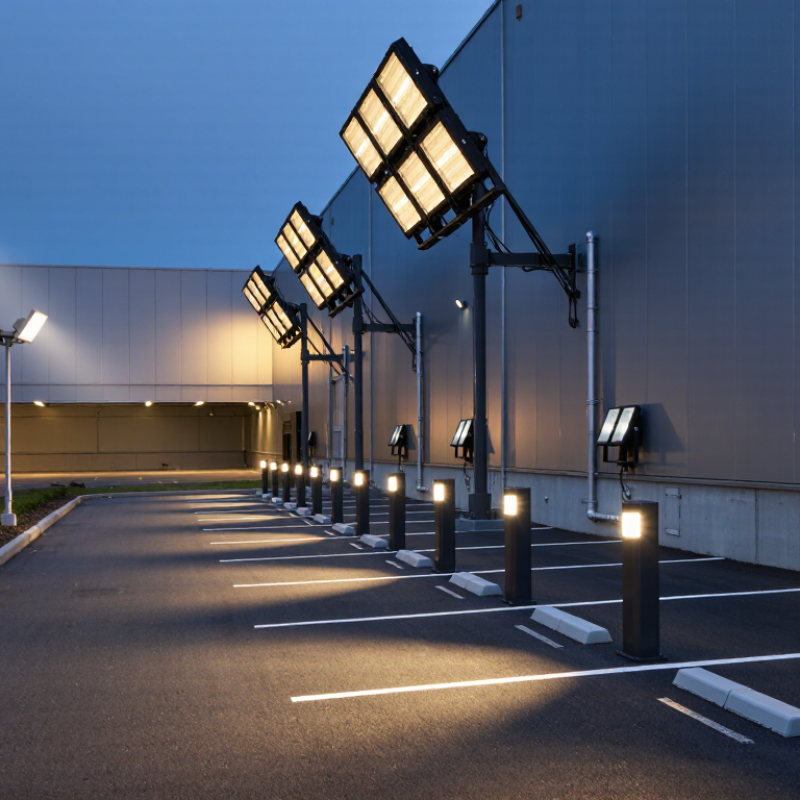
Define Commercial Exterior Lighting: Roads, Façades, Sites, and Parking Areas
Commercial exterior lighting covers fixtures and controls used outside buildings, where people travel, work, and park. It is not one product category. Road lighting helps drivers and pedestrians see routes, junctions, and obstacles. Its placement and light distribution matter as much as brightness. A bright pole can still leave dark patches.
Façade lighting makes building surfaces and entrances visible after dark, often using carefully aimed beams to limit glare. Site lighting serves yards, walkways, loading zones, and service areas. Parking-area lighting should help people notice vehicles, curbs, and walking routes. Each setting needs suitable optics, mounting heights, weather protection, and control options. Real sites are uneven; a tidy plan may miss a tree, sign, or neighboring window.
Tips: Match the lighting plan to the task, not just the fixture wattage. Ask for photometric layouts and check them against the site dimensions. Review glare, shadows, and maintenance access before installation. Small details get overlooked. A paper layout cannot fully predict how a wet surface will reflect light, so an on-site check may still be needed.
| Application | Primary Lighting Objective | Common Luminaire Types | Key Design Considerations | Useful Product and Project Checks |
|---|---|---|---|---|
| Roads and streets | Support visibility for drivers, cyclists, and pedestrians while limiting glare and uneven lighting. | Roadway LED luminaires, generally mounted on poles or outreach arms. | Road layout, mounting height and spacing, pavement characteristics, optical distribution, glare, and uniformity all affect the lighting design. | Review photometric files and project calculations. Check whether the proposed design follows the applicable road-lighting requirements, such as EN 13201 or ANSI/IES RP-8, as relevant to the project. |
| Building façades | Reveal architectural form, entrances, materials, or selected features without creating unnecessary spill light. | Wall washers, linear grazers, floodlights, and adjustable accent spotlights. | Consider beam angle, aiming, surface texture, viewing distance, color appearance, glare, and light trespass to neighboring properties. | Check beam distribution, color consistency, aiming options, dimming compatibility, and provisions for controlling upward and unwanted light. |
| Commercial sites and yards | Provide useful visibility for vehicle movement, loading, pedestrian routes, and general site activity. | Area lights, floodlights, and high-mast luminaires for larger open areas. | Account for site geometry, mounting locations, obstructions, vertical visibility, glare, spill light, and the lighting needs of different activity zones. | Ask for project-specific photometric layouts and confirm that optics, mounting arrangements, and controls suit the site plan and operating schedule. |
| Parking areas | Make parking spaces, circulation lanes, pedestrian paths, and entrances easier to see. | Area lights mounted on poles, with selected wall-mounted fixtures near buildings or walkways. | Plan for even coverage across parking bays and drive aisles, accessible routes, glare control, pole placement, and light spill beyond the lot. | Compare calculated coverage and uniformity with local requirements. Check dimming or occupancy-control options and their compatibility with the intended operating plan. |
| Product selection should be based on the project location, applicable codes, verified photometric data, environmental conditions, and the actual installation design. The standards listed are examples; the governing requirements vary by country and project. | ||||
Map China’s Manufacturing Hubs and Trace the Export Supply Chain
China’s exterior-lighting supply chain is concentrated, but not in one city. Guangdong’s Zhongshan, particularly Guzhen, and Foshan host networks for luminaires, aluminum housings, drivers, and finishing. Zhejiang and Jiangsu add metalworking, electronics, and export-oriented assembly. That matters. A supplier may source cast parts inland, assemble near the Pearl River Delta, then consolidate cartons at a coastal freight hub. Factory addresses do not tell the whole story.
UNCTAD’s Review of Maritime Transport 2024 reports that over 80% of world trade by volume moves by sea. The World Bank’s 2023 Logistics Performance Index ranked China 19th among 139 economies, a useful national-level signal, not a factory audit. Shenzhen, Guangzhou, Ningbo, and Shanghai can serve different routes, depending on origin, vessel schedules, and consolidation. Ask for the factory location, loading port, carton dimensions, and the forwarder’s booking point. Check whether the quoted lead time includes testing and final inspection. It often does not. Cluster maps can also age quickly; a trading office may sit far from the workshop.
China’s Commercial Lighting Export Routes: Port Capacity by Key Hub
Guangdong lighting clusters, including Zhongshan and Foshan, connect to export routes through ports such as Shenzhen and Guangzhou. Manufacturers in the Yangtze River Delta can ship through Shanghai and Ningbo-Zhoushan. The chart compares 2023 port container throughput (million TEU)—a logistics-capacity indicator, not lighting-specific export volume or manufacturer counts.
Source: 2023 port throughput figures reported by China’s Ministry of Transport and port authorities; values rounded.
Classify Chinese Manufacturers by Luminaire Type, Controls, and Market Segment
Best Commercial Exterior Lighting Manufacturers in China?
Chinese manufacturers are easier to compare when grouped by product type, control capability, and intended market. Some specialize in roadway luminaires, with asymmetric optics for poles along wide streets. Others focus on floodlights, wall-mounted fixtures, bollards, or linear canopy lighting. A factory’s strongest category may not be obvious from its full catalog. Ask for photometric files and test samples that match your actual mounting height and site conditions.
Controls create another useful dividing line. Basic products may offer photocells or 0–10V dimming, while more advanced ranges support motion sensing or networked control. Confirm the driver, sensor, and control protocol work together; a feature listed on a datasheet does not guarantee smooth commissioning. That matters outdoors. Market focus also varies: some suppliers serve contractors and distributors with standard project models, while others handle customized architectural orders or larger municipal and industrial projects. I would not rank manufacturers by catalog size alone. A polished PDF cannot show how consistently a batch performs.
Tips: Request current IP and IK ratings, lumen-maintenance data, warranty terms, and a sample before comparing quotations. Check lead times and spare-part availability, too. Details get missed. In my experience, one awkward point is that customization can improve fit but complicate replacement later. Document the exact fixture, driver, optics, and control setup before approving production.
Compare Efficacy in lm/W Using LM-79 Reports and LM-80 LED Data
When comparing commercial exterior lighting manufacturers in China, treat efficacy as a measured result, not a catalog promise. LM-79 reports test a complete solid-state lighting product and document its electrical and photometric performance. Check the reported lumens and input watts, then confirm the lm/W calculation matches the same fixture configuration. Look for test conditions such as voltage, CCT, and ambient temperature. Small differences matter.
Read the details, not just the headline. A 150 lm/W floodlight may use a narrow beam, while a lower-efficacy model could spread light more evenly across a loading bay. Compare beam distribution, glare control, and mounting height alongside efficacy. Ask for the full LM-79 report, including the tested model and date. A neat spreadsheet can still mislead.
LM-80 data serves a different purpose. It measures lumen maintenance for LED packages, modules, or arrays under specified conditions; it does not directly prove a fixture’s lifetime or system efficacy. Review the LED type and test duration, and treat projected maintenance cautiously. Heat changes the picture. In a real installation, driver losses, optics, and hot enclosures can affect output. I would verify these details before ranking products, even when the paperwork looks polished.
Verify Durability with IEC 60529 IP66 and IEC 62262 IK08 (5 J) Ratings
When comparing commercial exterior lighting manufacturers in China, verify enclosure ratings against IEC 60529 and IEC 62262—not just product photographs. IP66 means the housing is dust-tight and tested against powerful water jets; it does not mean the fixture can be submerged. IK08 represents resistance to a 5-joule impact. That is useful near loading bays, walkways, and service roads, where a dropped tool or accidental knock can damage exposed equipment.
Ask for test reports matching the exact fixture model, including its installed lenses, cable entries, and mounting configuration. A rating is not a promise of zero maintenance. The U.S. Department of Energy’s report, LED Luminaire Lifetime: Recommendations for Testing and Reporting, cautions that LED package data alone cannot establish complete luminaire life; drivers and thermal conditions matter too. Check the report’s laboratory, test date, and sample details. Then inspect gaskets, fasteners, and drainage paths.
Small details.
A poorly seated seal can undermine an otherwise strong enclosure rating, and certificates do not show how carefully each production unit was assembled.
Related Posts
-
Ultimate Guide to Selecting the Best Outdoor Lighting Fixtures for Your Next Project
-
China's Commercial Exterior Lighting Leading Growth Amidst US China Tariff Challenges
-

Top 10 Outdoor Lighting Solutions You Need to Know?
-

What Are the Top Commercial Lighting Types in 2026?
-
Global Trust in Chinese Craftsmanship for Best Exterior Light Fixtures
-

2025 Commercial LED Innovations: Essential Strategies and Insights for Global Buyers