10 Smart Lighting Buying Tips for Global Buyers
Smart Lighting can make a room more comfortable, efficient, and easier to manage. But choosing the right system takes more than comparing prices or counting features. A bulb that works well in one home may flicker with another dimmer, connect poorly to a different network, or require a voltage that the destination market does not support. Small details matter.
For global buyers, product specifications deserve close attention. Compare lumen output, color temperature, dimming range, control options, and stated service life. Check whether the system uses Wi-Fi, Bluetooth, Zigbee, or another protocol, and confirm that it suits the intended installation. A warm 2700K lamp may feel inviting in a bedroom, while a brighter, cooler setting may suit a work area. The best choice depends on how people actually use each space.
Reliable purchasing also means reviewing manufacturer documentation, warranty terms, replacement availability, and relevant requirements in the destination market. Ask for clear datasheets rather than relying on vague claims such as “energy-saving” or “easy to install.” Check app support and update policies, too. A sophisticated feature is not useful if it is difficult to maintain. And a low purchase price can become a false economy when compatible components are hard to source. There is no perfect setup for every buyer. These 10 Smart Lighting buying tips offer a practical way to compare options, ask sharper questions, and make a more informed decision.
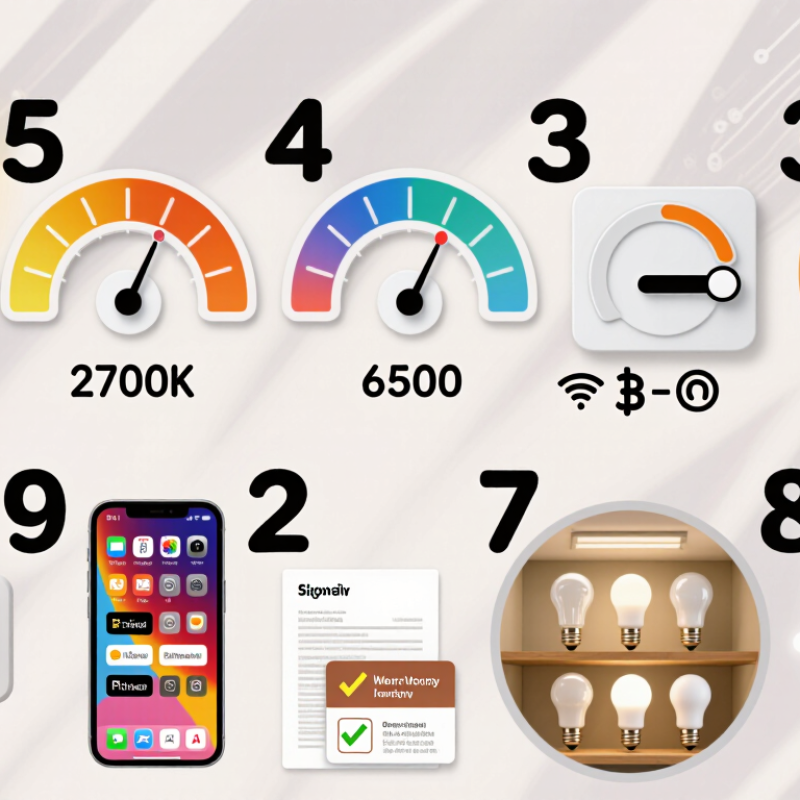
Define Lighting Needs, Spaces, and Control Goals
Before comparing fixtures, define what each space needs to do. A kitchen may need bright, even light over counters, while a bedroom benefits from softer light near the bed. Note ceiling height, room size, window direction, and existing wiring. These details affect fixture placement, brightness, and installation effort. Write down the main task for each area, such as reading, cooking, or welcoming visitors.
Tip: Make a simple room list. Add the desired mood, approximate lighting hours, and who will use each space. Then decide how you want to control the lights: wall switch, dimmer, timer, or app. Check that controls suit daily routines. For example, a hallway timer may be more useful than opening an app with full hands.
Set a practical brightness target, and consider adjustable color temperature where activities change throughout the day. Confirm that proposed controls work with the selected fixtures and your electrical setup. Compatibility can be easy to overlook. Even a careful plan may miss glare on a glossy countertop or a dark corner beside a wardrobe. Mark these spots on a room sketch, then review the layout at different times of day before ordering.
10 Smart Lighting Buying Tips for Global Buyers - Define Lighting Needs, Spaces, and Control Goals
| Tip | Space or goal | What to define | Buyer check |
|---|---|---|---|
| 1. Start with the task | Kitchen counters, desks, reading areas | List the activities and decide whether the priority is general, task, accent, or a combination of lighting. | Compare delivered lumens and beam distribution, not wattage alone; watts describe power use, not light output. |
| 2. Map each room separately | Open-plan rooms, bedrooms, corridors, work areas | Record room dimensions, ceiling height, surface colors, daylight, and existing fixture locations. | Ask for a lighting layout or sample installation when room size, ceiling height, or finishes may affect results. |
| 3. Set a target light level | Task zones and circulation areas | Specify desired illuminance in lux at the work plane; needs differ by task, user, and local guidance. | Request a lighting calculation for critical work areas rather than relying on a single lumen-per-room estimate. |
| 4. Choose the color of light | Relaxation, focused work, hospitality, display lighting | Select a color temperature in kelvin or specify tunable white if users need to change it. | Confirm the available color-temperature range and whether brightness can be adjusted at each setting. |
| 5. Check color rendering | Retail displays, kitchens, art areas, grooming spaces | Set a color-rendering requirement appropriate to the application; CRI is commonly used for basic comparison. | Review the product’s photometric data and, for color-critical work, request additional color-quality information or a sample. |
| 6. Confirm dimming behavior | Bedrooms, meeting rooms, dining areas, presentation spaces | Define the desired dimming range, control method, and whether smooth low-level dimming is important. | Verify compatibility among the light, driver, dimmer, and control system; test for flicker, noise, and minimum-level performance. |
| 7. Match controls to users | Homes, offices, hospitality, shared spaces | Choose the mix of wall controls, mobile app, schedules, occupancy sensing, and remote access. | Check what still works if the internet or app is unavailable, and whether guests can use a simple local control. |
| 8. Plan connectivity and integration | Multi-room projects, commercial sites, connected buildings | Document the required communication protocol, network coverage, system integrations, and number of devices. | Confirm interoperability, commissioning requirements, software support, and cybersecurity or data-handling needs. |
| 9. Check the installation environment | Bathrooms, exterior areas, enclosed fittings, hot or cold locations | Specify mounting type, operating temperature, exposure to moisture or dust, and required ingress protection. | Match the luminaire’s documented rating to the actual location and follow applicable local electrical and installation rules. |
| 10. Compare lifecycle and service needs | Large projects, hard-to-reach fittings, long operating hours | Compare energy use, rated life assumptions, warranty terms, replaceable components, and maintenance access. | Review test reports, local compliance documentation, spare-part availability, and total cost over the expected service period. |
Related Posts
-
What Are the Top 10 Smart Lighting Systems for Global Buyers?
-
10 Essential Reasons Why Best Smart Lighting is the Future of Energy Efficiency
-
Exploring the Advantages and Applications of Smart Lighting Systems in Modern Enterprises
-

Navigating the Future of Smart Lighting Systems in 2025 Strategies for Global Buyers
-
Revolutionizing Lighting: The Impact of LED Luminaires on Energy Savings and Sustainability
-

What Are Industrial LED Light Fixtures?