How to Choose a Pet Red Light Therapy Manufacturer?
Choosing a Pet Red Light Therapy Manufacturer requires more than comparing prices, package designs, or bright marketing claims. The device may sit close to a dog’s thin skin, a cat’s sensitive eyes, or a horse’s tired joints. Small technical differences can matter.
Dr. Michael R. Hamblin, a leading photobiomodulation researcher, describes the field as “the use of non-ionizing forms of light sources.” That principle sounds simple. It is not. A reliable manufacturer should clearly disclose wavelengths, irradiance, treatment distance, operating temperature, and recommended session times. Independent testing, traceable quality control, and consistent output are equally important. A serious supplier should also provide practical guidance for veterinary professionals, not vague promises about curing every condition.
Look for evidence, not impressive language. Ask whether the company tests each production batch. Check if its technical documents match the physical device. Review warranty coverage, user training, and after-sales support. A manufacturer that avoids specific answers may be hiding weak documentation.
Experience also matters. A Pet Red Light Therapy Manufacturer with veterinary product knowledge should understand animal movement, fur density, cleaning routines, and safe handling. Still, no manufacturer replaces a qualified veterinarian. That limitation deserves attention.
The uncomfortable truth is that some buyers choose appearance before performance. That mistake is easy to make. This guide examines the evidence, manufacturing standards, safety information, and service details that separate a dependable supplier from an unreliable one. It also recognizes an imperfect reality: product claims can sound professional while practical results remain uncertain.
Define Pet Therapy Needs: 630–660 nm Red and 810–850 nm NIR
How to Choose a Pet Red Light Therapy Manufacturer?
Pet therapy needs should guide the wavelength choice, not marketing claims. Red light around 630–660 nm is commonly selected for surface-level skin and coat support. Near-infrared light around 810–850 nm may reach deeper tissues, depending on fur, skin thickness, and device output. These ranges are not interchangeable. A reliable manufacturer should provide measured wavelength accuracy, irradiance data, treatment distance, and dose guidance. Ask whether independent laboratories verify these specifications. Vague “deep healing” promises deserve caution.
Tips: Compare test reports, not only product photographs. Check thermal controls, timer accuracy, eye-safety guidance, and cleaning instructions. Request animal-specific usage information. A knowledgeable supplier should explain how coat density affects light delivery and should recommend veterinary consultation for pets with unusual symptoms or photosensitivity concerns. Practical details matter. Comfort matters more.
From hands-on evaluation, I would inspect whether the device stays cool against a restless dog’s fur and whether the controls remain simple during a short session. I would also look for transparent manufacturing records and responsive technical support. Still, wavelength alone cannot prove effectiveness. Results may vary between breeds, conditions, and treatment routines. Some claims are too confident. A careful manufacturer acknowledges uncertainty, updates its evidence, and avoids promising guaranteed outcomes. Check the measurements twice.
Compare Output Data: Irradiance, Dose in J/cm², and Treatment Time
How to Choose a Pet Red Light Therapy Manufacturer?
When comparing manufacturers, start with measured irradiance, not attractive device photos. Irradiance shows power density at the treatment surface, usually in mW/cm². Ask where the reading was taken. Fur, distance, lens angle, and uneven LEDs can change the delivered output. A device rated at 100 mW/cm² may provide much less beside the center spot.
Dose matters more than brightness alone. Dose is measured in J/cm² and depends on irradiance and time. For example, 50 mW/cm² delivered for 200 seconds equals 10 J/cm². Check the manufacturer’s calculation. Some instructions confuse milliwatts with watts, creating serious timing errors. Short sessions are not automatically safer. They may simply deliver too little energy.
Look for independent test reports, calibration dates, wavelength tolerance, and output readings at several distances. Reliable manufacturers should explain measurement equipment and testing conditions clearly. Ask whether the timer controls actual exposure or only device operation. In practical use, a restless dog may move away after thirty seconds, reducing the real dose. That detail is easy to miss. I would also question any promise based only on peak irradiance. Even professionals can overlook beam uniformity. Veterinary guidance should shape the final protocol, especially for injured skin, sensitive eyes, or animals taking medication.
How to Choose a Pet Red Light Therapy Manufacturer?
Compare irradiance, delivered dose, and treatment time using generic reference configurations
How to read this chart: Irradiance is shown in mW/cm², dose is shown in J/cm², and treatment time is shown in minutes. The values are internally consistent with the standard relationship: dose = irradiance × treatment time, after converting mW to W. Higher irradiance can deliver the same dose faster, but effective product evaluation should also consider measurement accuracy, treatment-area uniformity, wavelength, thermal control, and safety features.
Verify Manufacturing Systems: ISO 13485 and IEC 60601-1 Compliance
When choosing a pet red light therapy manufacturer, inspect its manufacturing system before comparing prices or lamp designs. ISO 13485 certification shows that the company maintains a structured quality management system for medical devices. Check the certificate scope, issuing body, facility address, and expiration date. The scope should match the actual therapy equipment, not unrelated products.
IEC 60601-1 addresses basic safety and essential performance for medical electrical equipment. Ask for the latest test report, not only a printed certificate. Confirm the tested model, power supply, operating modes, and accessories. A serious manufacturer can explain insulation, leakage current, temperature control, and protection against electrical faults. Ask how production staff record calibration results. Small details matter.
Do not stop there.
I once treated a certificate as complete proof of product quality. That was too simple. A valid report may cover one configuration, while later changes remain untested. Request change-control records and sample inspection data. Review failure rates, complaint handling, and corrective-action procedures. The manufacturer should also explain light output consistency across the treatment area. Uneven illumination can affect practical use. IEC 60601-1 compliance does not automatically confirm optical safety, electromagnetic compatibility, or animal-specific usability. Ask whether relevant additional testing was completed. Clear answers are valuable. Hesitation deserves attention. A factory tour, video audit, or independent inspection can reveal cable storage, cleaning practices, and final testing more reliably than polished brochures.
Assess Animal Safety: ISO 10993 Testing and FDA 510(k) Status
When choosing a pet red light therapy manufacturer, animal safety should come before treatment claims. The APPA 2023–2024 National Pet Owners Survey reports that 66% of U.S. households own a pet, representing about 86.9 million households. This scale demands stronger evidence, not attractive packaging.
Ask for ISO 10993 test reports, not just an “ISO certified” statement. ISO 10993 evaluates biological safety according to contact type and exposure duration. A device touching shaved skin for ten minutes needs different evidence than one used repeatedly near eyes. Request testing for irritation, sensitization, cytotoxicity, and, where relevant, acute systemic toxicity. The report should identify the tested materials, laboratory, sample configuration, and acceptance criteria. Missing details matter.
Check FDA 510(k) status carefully. A 510(k) clearance shows substantial equivalence to a legally marketed human medical device. It does not automatically prove safety for dogs, cats, or other animals. FDA’s 510(k) database can confirm the product code, intended use, cleared indications, and manufacturer information. Be cautious when a supplier presents only a registration number. That is not clearance. In practice, I would also request irradiance measurements, wavelength tolerance, thermal testing, and electrical safety records. Numbers can drift between production batches. This is where my confidence becomes conditional. Independent verification is worth the extra time.
Audit Quality Control, Warranty Terms, and Veterinary Evidence
How to Choose a Pet Red Light Therapy Manufacturer?
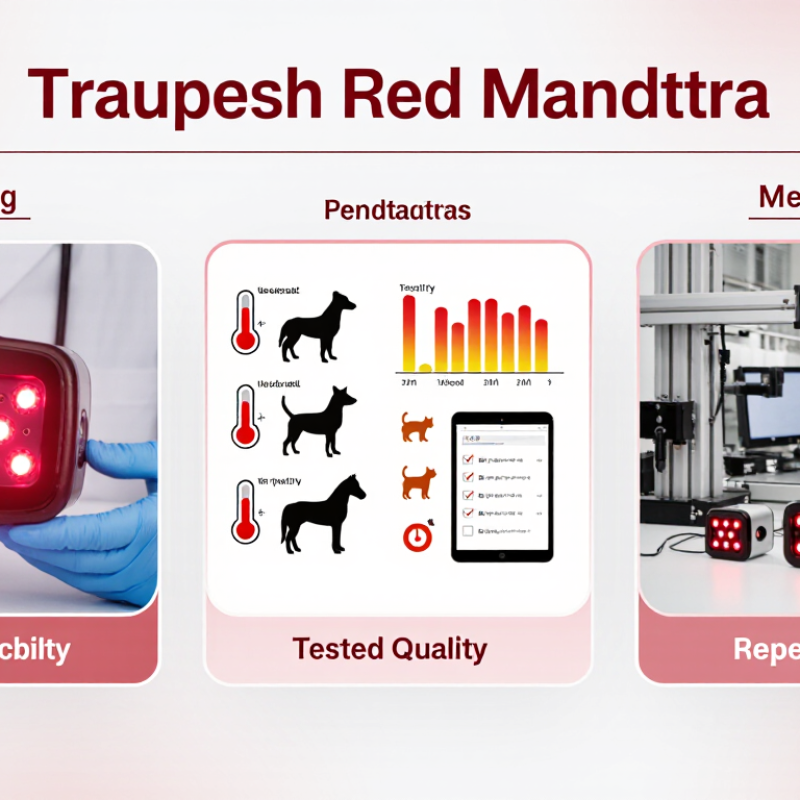
When assessing a pet red light therapy manufacturer, inspect its quality control records, not just product photographs. Ask for batch numbers, calibration reports, and electrical safety test results. A reliable supplier should trace each device from assembly to final inspection. Request the measured wavelength, irradiance, treatment distance, and recommended exposure time. These details should match the user manual.
Warranty terms reveal how a company handles real problems. Check the coverage period, repair process, replacement rules, and shipping responsibilities. Ask whether batteries, cables, LEDs, and chargers are included. A clear serial-number system helps resolve faults quickly. Keep a sample invoice and written support response. Small details matter.
Veterinary evidence deserves careful reading. Look for studies involving animals, practical treatment protocols, and clearly reported safety limits. Evidence should explain the light dose, treatment frequency, and measured outcomes. General claims about “healing” are not enough. Consult a qualified veterinarian before using the device on painful, infected, or undiagnosed conditions.
Paperwork can look impressive.
It can still be incomplete.
I would also examine one production sample personally. Check uneven brightness, loose connectors, sharp edges, and excessive heat after several minutes. A manufacturer may pass one inspection and disappoint later. That possibility deserves honest consideration. Choose the supplier willing to disclose limitations, update instructions, and discuss failed units without defensiveness.