Top 10 Best Hair Diffusers for Curly Hair
Curly hair rarely dries evenly. One section may form soft spirals, while another stays damp near the roots. A diffuser can spread airflow across curls instead of concentrating it in one harsh stream. The right attachment may help preserve definition and reduce the rough, frizzy finish that fast drying sometimes leaves behind. Small details matter.
The market reflects a growing interest in styling tools: Grand View Research estimated the global hair dryer market at USD 9.2 billion in 2023 and projected further growth through 2030. That figure describes the wider dryer market, not proof that any diffuser performs well. For hair health, the American Academy of Dermatology advises limiting heat styling and using the lowest effective heat setting. These points make airflow, heat control, bowl depth, and fit worth examining—not just brand claims.
This guide compares the best hair diffusers for curly hair by practical features, including compatibility, ease of handling, and how gently each model distributes air. A deep bowl can hold longer curls; a lighter attachment may feel easier during a slow drying session. No tool is magic. Results still depend on curl pattern, technique, and heat exposure, and product descriptions rarely capture every real-world drawback. Consider this a careful shortlist, not a promise of identical results for every head of curls.
How Hair Diffusers Help Shape and Dry Curly Hair
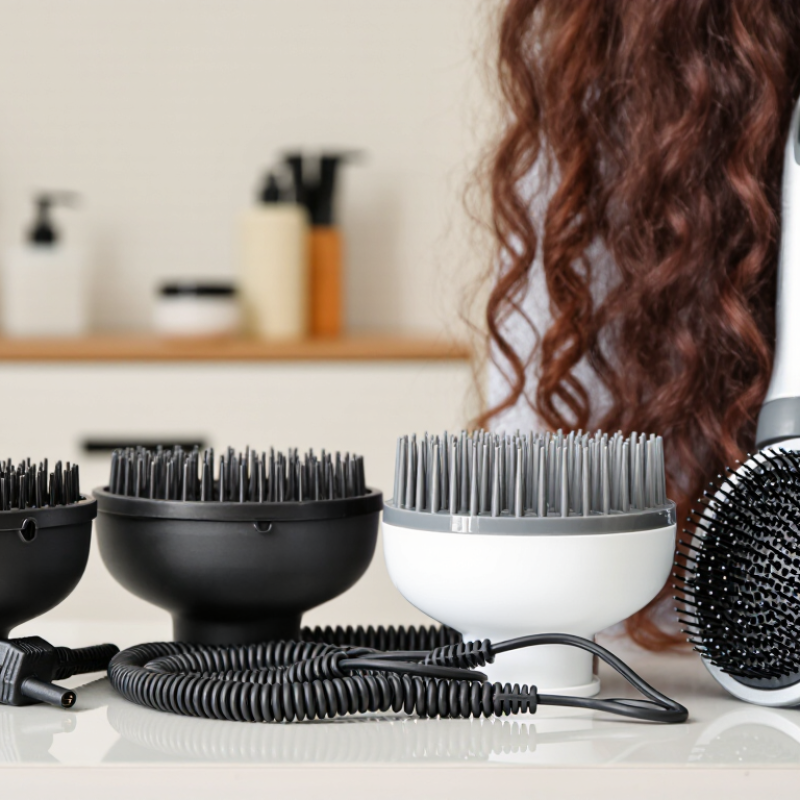
A hair diffuser spreads a dryer’s airflow across a wider area instead of concentrating it on one spot. Its bowl supports curls while the prongs lift roots, helping hair dry with less direct disturbance. Use it on damp, conditioned hair, placing sections gently in the bowl rather than pulling them taut. This can help curls keep their clumps and spring. It cannot create a curl pattern that is not already there.
Heat and distance still matter. A 2011 laboratory study in Annals of Dermatology measured hair-surface temperatures of about 47°C with a dryer held 15 centimeters away, compared with about 95°C at 5 centimeters. The study did not test every diffuser, so those figures are not a guarantee of safe temperatures. A diffuser can still expose hair to damaging heat. Choose a lower setting, keep the dryer moving, and pause if your scalp feels uncomfortably hot.
For more definition, tilt your head and let the diffuser meet the curls from below. Hold each section still for a short interval; constant repositioning can scatter wet strands and create frizz. Roots may need extra time. Patience helps. Some curls will dry unevenly, especially in dense sections, and that is not necessarily a technique failure. Avoid touching the hair repeatedly while it dries, though the urge is real. When the roots feel dry, stop rather than chasing a perfectly uniform finish.
| Rank | Diffuser Style | Best Suited For | How It Helps Shape and Dry Curls | What to Check |
|---|---|---|---|---|
| 1 | Deep-Bowl Diffuser | Medium-to-long curls and larger sections | The bowl can hold a section of curls while warm air is spread across it, making it easier to dry without directing a concentrated stream at individual strands. | Choose a bowl that can comfortably hold your curl sections and fits your dryer securely. |
| 2 | Wide-Bowl Diffuser | Thick hair or broad curl sections | A wider surface distributes air over more hair at once, which can make section-by-section drying more convenient. | A wide bowl may be bulky; check its weight and dryer compatibility. |
| 3 | Long-Prong Diffuser | Long, dense, or tightly curled hair | Longer prongs can help lift and separate hair near the roots, allowing airflow to reach areas that may otherwise stay damp. | Use a gentle setting and avoid pushing prongs forcefully through curls. |
| 4 | Short-Prong Diffuser | Short-to-medium hair and looser curl patterns | Shorter prongs provide support while curls are cupped in the diffuser, with less reach into the hair than longer-prong designs. | Check that the bowl is large enough for your usual section size. |
| 5 | Multi-Prong, Vented Diffuser | People who want airflow distributed across several contact points | Openings around the bowl and prongs spread airflow through the attachment, rather than relying on one narrow air stream. | Airflow and heat depend on the dryer settings as well as the attachment design. |
| 6 | Adjustable-Fit Diffuser | Households with different dryer shapes or sizes | An adjustable collar or flexible connector can make attachment fit more adaptable across compatible dryer outlets. | “Universal” does not guarantee a secure fit; confirm the outlet measurements and attachment instructions. |
| 7 | Collapsible Silicone Diffuser | Travel and limited storage space | Its foldable body packs more compactly than many rigid attachments and can still spread air when fully opened. | Let it cool before folding, and check that it is suitable for your dryer’s heat and airflow. |
| 8 | Compact Travel Diffuser | Travelers and occasional use | A smaller attachment takes up less space and can be useful for drying smaller sections or shorter hair. | Its smaller bowl may take more passes to dry long or dense hair. |
| 9 | Soft Fabric or Sock Diffuser | Gentle, low-airflow drying preferences | The fabric spreads air through a soft covering, which can soften the direct force of airflow compared with an uncovered dryer outlet. | Follow care and heat guidance; fabric attachments are not suitable for every dryer or setting. |
| 10 | Shallow-Bowl Diffuser | Short hair, loose waves, or gentle root drying | The shallow shape offers a broad surface for lightly cupping hair and can be easier to handle than a deeper bowl. | It may hold less hair at once and may be less convenient for long curls. |
| Selection note: These rankings compare general diffuser designs, not specific products. A diffuser disperses a dryer’s airflow to help dry curls while reducing direct, concentrated air on the hair; results also depend on dryer heat and speed, hair density and length, and drying technique. Use a low or moderate airflow setting if you want to limit curl disturbance, and check attachment fit before use. | ||||